A courtroom is the perfect room for a movie. Two sides, one version of the truth has to win, and a jury of strangers deciding which one — all of it conducted in a language that's half ritual, half street fight. The great legal dramas know the trial is never really just about the defendant. It's about prejudice, power, money, conscience — whatever a society is currently arguing with itself about. These are the films that define the genre, and yes, the old ones absolutely hold up.
The Classics (Yes, They're Worth It)
12 Angry Men (1957) basically never leaves one room. Sidney Lumet's first film locks twelve jurors in a sweltering deliberation room where eleven of them are ready to send a teenager to the chair and get home for dinner. Henry Fonda's Juror 8 just wants them to actually talk about it first. That's the whole film — talking — and it's more tense than most action movies, because you watch prejudice crack in real time, one holdout at a time. It was made for very little money. It shows you don't need any. If you watch one film on this page, make it this one.
To Kill a Mockingbird (1962) gave cinema its ultimate moral hero in Gregory Peck's Atticus Finch, defending a Black man falsely accused in a Depression-era Alabama town where the verdict is more or less decided before anyone speaks. Told through his daughter Scout's eyes, the trial becomes a lesson in standing up when standing up will cost you — and Peck's closing argument is still one of the most quoted speeches in film history, deservedly.
Witness for the Prosecution (1957) is Billy Wilder taking an Agatha Christie story and making it sparkle the way he made everything sparkle. Charles Laughton plays a brilliant, ailing barrister defending a charming young man accused of murder, and every witness who takes the stand turns the case a quarter-turn. Christie herself thought it was the best adaptation of her work. She wasn't wrong about much.
The Modern Landmarks
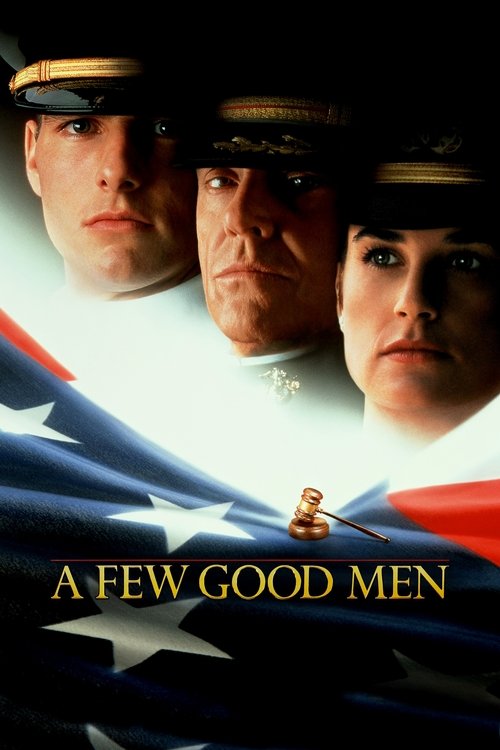
A Few Good Men (1992) gives Tom Cruise a Navy lawyer who's never actually argued a case — he plea-bargains everything — and then hands him one he can't settle: two Marines accused of a killing they say they were ordered to commit. Aaron Sorkin's script zings, Rob Reiner directs it like he knows exactly how good it is, and then Jack Nicholson takes the stand as Colonel Jessup and produces the most famous cross-examination explosion in modern movies. "You can't handle the truth" is a cliché now. It's a cliché because the scene was too good not to steal from.
Philadelphia (1993) was one of the first big Hollywood films to confront the AIDS crisis head-on. Tom Hanks — Oscar in hand for this one — plays a lawyer fired once his illness becomes obvious, and Denzel Washington plays the only attorney who'll take the case, a man who has to work through his own prejudices in the process. The courtroom is the setting, but the real trial happens inside everyone in the room.
And Erin Brockovich (2000) proves you don't even need a big courtroom climax. Julia Roberts, also Oscar-winning, plays a single mum with zero legal training who bluffs her way into a job at a small firm and starts pulling at a thread — a utility company, a town's water supply — that unravels into something enormous. Soderbergh shoots paperwork and door-knocking like they're action scenes. Somehow, they are.
More Trials Worth Your Time
- The Verdict (1982) — Paul Newman as a washed-up lawyer who turns down the settlement and bets what's left of his life on one malpractice trial. Lumet again, and it's Newman's finest late performance.
- Anatomy of a Murder (1959) — James Stewart defends a soldier who openly admits killing his wife's alleged attacker. Jazz score, moral grey areas everywhere, startlingly modern for 1959.
- Judgment at Nuremberg (1961) — Spencer Tracy presiding over German judges who served the Nazi regime. Sober, devastating, and impossible to shake off.
- Kramer vs. Kramer (1979) — a custody battle with Hoffman and Streep where the film refuses to pick a villain. The courtroom scenes hurt precisely because both parents are right about some things.
- My Cousin Vinny (1992) — the genre's great comedy and, lawyers will tell you, secretly one of its most accurate trial films. Marisa Tomei's testimony scene is perfect cinema and actually correct law.
- The Trial of the Chicago 7 (2020) — Sorkin again, on the chaotic 1969 trial of anti-war protesters, where the system itself ends up looking like the thing on trial.
Real Courtrooms vs. Movie Courtrooms
Honesty corner: real trials are slow, dry, and almost never feature a surprise witness bursting through the doors. Nobody confesses on the stand. And yet — lawyers keep ranking several films on this page among the ones that capture why they chose the job, because the bones are right: the preparation, the strategy, the crushing weight of the burden of proof. That's why these films, some of them pushing seventy years old, still feel urgent the moment someone calls the court to order. Words are the weapons here, verdicts are just the surface, and the real drama is what people will say, hide, and believe in order to win. All rise.